Last updated November 18, 2026
How to Hire an ADU Contractor in Winchester: A Step-by-Step Guide
Most homeowners think the hard part of hiring a contractor is picking a price. It isn’t. The question “can I see your license?” is the floor, not the ceiling. A licensed contractor can still send an unlicensed, unvetted subcontractor to your property the moment your back is turned, and in Winchester that gap between who signs the contract and who actually shows up is where projects quietly go wrong. This guide gives you the interview framework, the license checks, and the contract clauses that separate a builder who finishes from one who disappears.
Key Takeaways
- 1
Verify the contractor’s Nevada license classification yourself on the NSCB database in under three minutes before you sign anything.
- 2
“Who signs the contract” and “who physically shows up” are two different questions. Get both answers in writing.
- 3
A suspiciously low ADU bid usually signals underpaid, replaced, or unlicensed labor, not a bargain.
- 4
Three contract clauses protect you: change-order caps, substitution approval rights, and lien waiver timing.
- 5
Ask about background checks and photo ID badges before a crew is in your backyard, not after.
Quick Answer
To hire an ADU contractor in Winchester, verify their Nevada license classification and standing on the NSCB database, confirm in writing which specific people will enter your property, and insist on a written fixed price plus a workmanship guarantee before work starts. A legitimate contractor will welcome all three checks. One who dodges any of them is telling you something.
Table of Contents
- Understanding Winchester ADU Rules and Lot Constraints
- The Nevada License Classification That Actually Covers ADU Work
- How to Verify a Contractor on the NSCB Database in Under Three Minutes
- Who Physically Shows Up: The Question Most Homeowners Skip
- How to Read a Contract for the Three Clauses That Protect You
- Red Flags in ADU Bids: What a Suspiciously Low Estimate Signals
- Prefab vs. Site-Built: What to Ask Each Type of Builder
- The Interview Questions That Expose the Difference
If you’re still mapping out the project itself, our ADU builders in Winchester page covers unit sizes, types, and what fits a typical lot. This guide stays on the hiring decision.
Understanding Winchester ADU Rules and Lot Constraints
Before you interview anyone, understand what your lot will actually allow. Winchester sits in the Las Vegas Valley, where summer highs routinely push past 105°F and the ground bakes hard and dry for months. That climate shapes ADU work in specific ways: shade structures and adequate insulation aren’t luxuries, roof and wall assemblies need to handle intense solar load, and drainage has to account for the rare but violent monsoon downpour that arrives fast in late summer. A contractor who has never built in this heat will undersize the cooling and you’ll feel it every July.
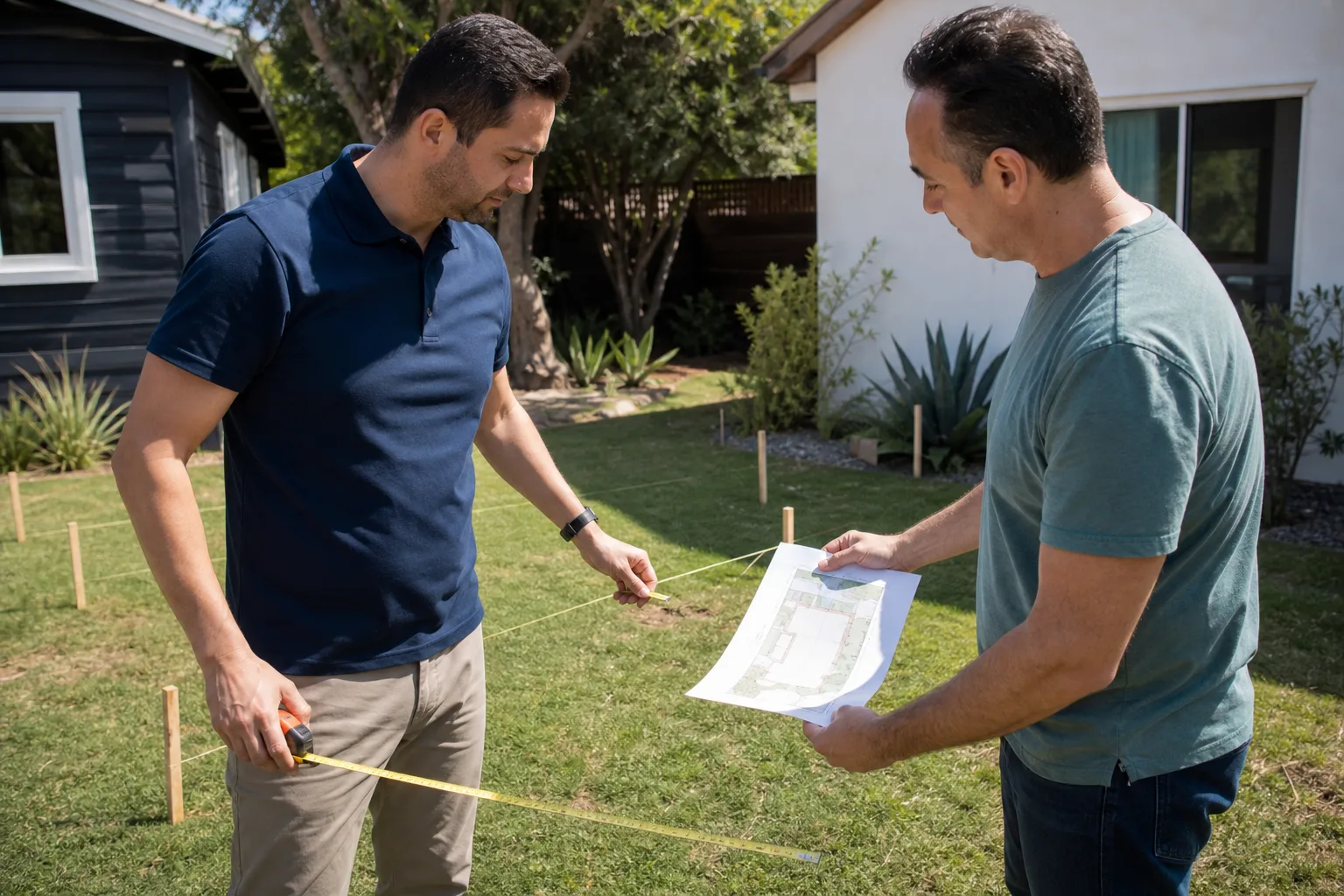
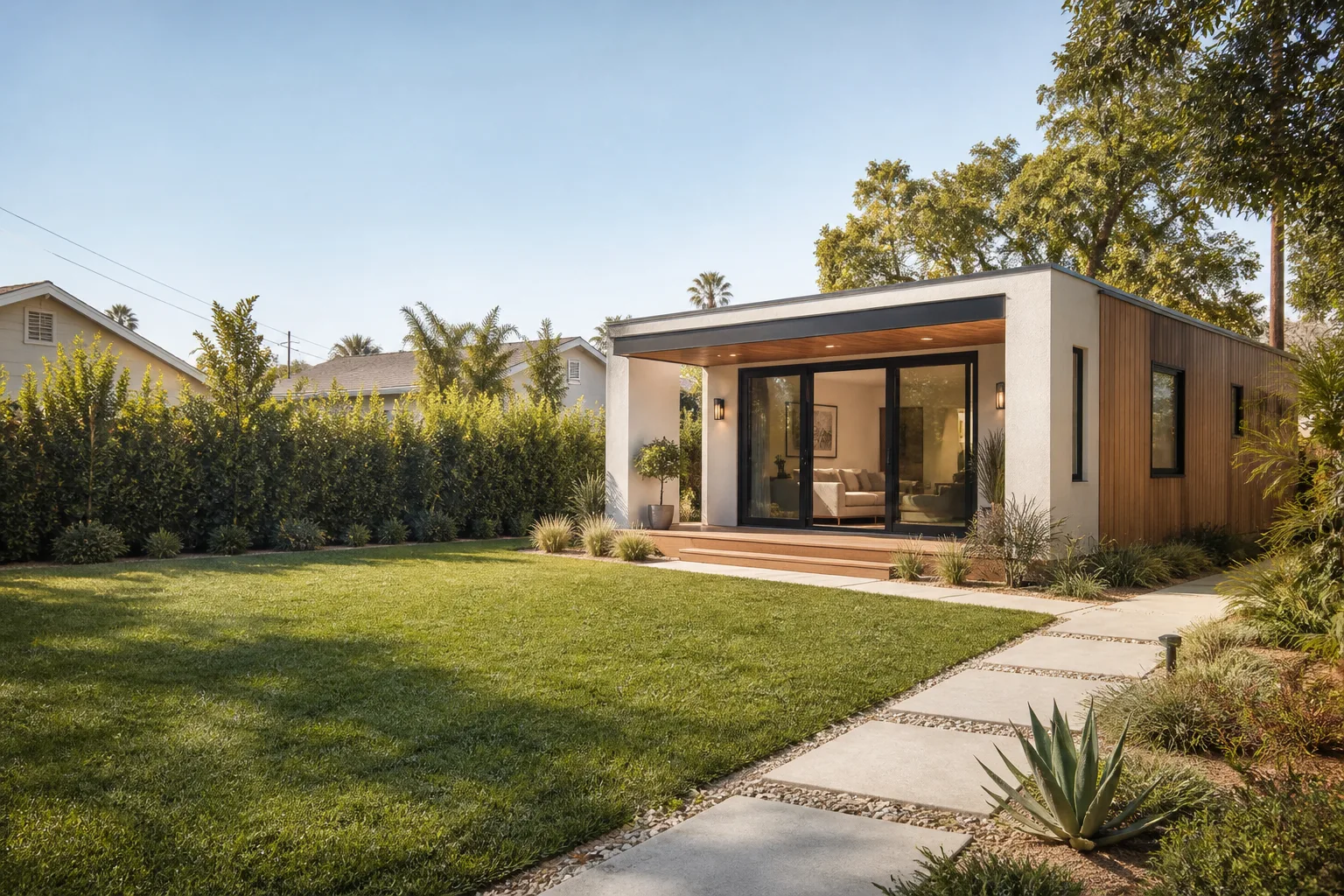
Winchester is an unincorporated community in Clark County, so ADU permitting and zoning run through Clark County rather than a separate city hall. Lot coverage, setbacks (the required gap between your new structure and the property line), and height limits all apply. In our experience, the older lots around Winchester and the adjacent neighborhoods near the Strip corridor often have tighter side yards than newer developments, which pushes many homeowners toward a detached unit set toward the back of the lot or a garage conversion rather than a wide addition.
Ask each contractor:
- Have you pulled ADU permits through Clark County, and can you describe the process?
- How does this specific lot’s setback and lot-coverage picture affect what I can build?
- What do you specify for insulation, roof assembly, and cooling in this climate?
If you’re weighing a garage conversion against a ground-up build, our room addition contractor in Winchester guide explains where the two diverge in cost and complexity.
The Nevada License Classification That Actually Covers ADU Work
This is where a lot of homeowners get fooled. Nevada licenses contractors by classification, and the classification has to match the scope of work. An ADU is a full residential structure: it involves framing, electrical, plumbing, mechanical, and finish trades under one contract. A contractor holding a narrow specialty license may legally be able to do part of that work but not manage the whole build. When you hire them anyway, the parts they can’t legally cover get quietly handed to someone else, and that someone else is the person in your backyard.
A general building or residential classification is what you want to see for a whole-ADU contract. Ask the contractor to state their classification in writing and to tell you which portions, if any, are subcontracted. There’s nothing wrong with subcontracting the electrical or plumbing to licensed trade specialists. The problem is when it happens without your knowledge or approval.
Two questions cut through this fast:
- “What is your Nevada license classification, and does it cover the entire ADU from foundation to finish?”
- “Which trades will be performed by subcontractors, and are all of them licensed and insured?”
A straight answer comes quickly. A vague one (“we’re fully licensed, don’t worry”) is your cue to verify on your own.
How to Verify a Contractor on the NSCB Database in Under Three Minutes
The Nevada State Contractors Board maintains a public license lookup, and you should use it on every bidder, no exceptions. This is the single most useful three minutes you’ll spend on the project. Here’s the process:
- Go to the NSCB license search and enter the contractor’s license number or business name.
- Confirm the license status reads active, not expired, suspended, or revoked.
- Check the classification listed and make sure it matches ADU or full residential work.
- Look for any complaint or disciplinary history disclosed on the record.
- Confirm the business name on the license matches the name on your contract and bid.
That last step matters more than people realize. A bid can carry one company name while the license belongs to a different entity entirely. If the names don’t match, ask why. In Winchester, where plenty of small operators work the valley, name mismatches are one of the most common ways an unlicensed crew ends up on a job.
Screenshot the result and keep it with your project file. If anything goes sideways later, you’ll want the record of what the license status was on the day you hired.
Who Physically Shows Up: The Question Most Homeowners Skip
“Who signs the contract” and “who shows up at my door” are two separate questions, and almost nobody asks the second one until a stranger is already in the backyard. For a build that runs weeks or months, a rotating cast of unfamiliar faces on your property is a genuine concern, especially for homeowners who are often home alone, parents with young children, or older residents.
So ask directly, and get it in writing:
- Will the people who arrive be employees, regular subcontractors, or day labor?
- Are they background-checked and identity-verified, or just screened by whoever runs the crew?
- Will I be told their names and shown a photo before they arrive?
- Will they carry photo ID badges and wear marked uniforms?
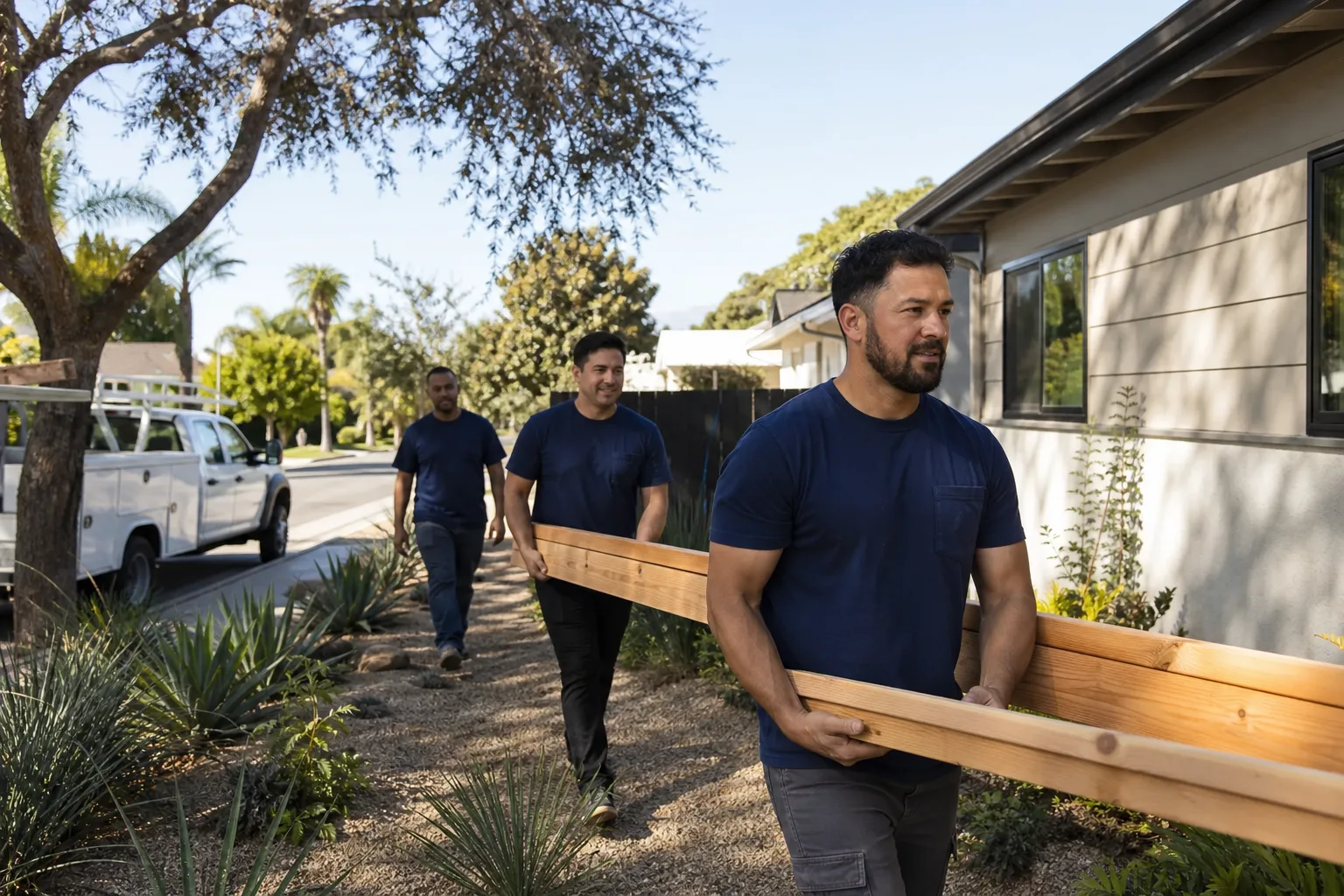
This is where a documented crew standard matters. The Threshold Standard, which governs our work at Sutton ADU Builders Winchester, means every technician is background-checked and identity-verified, and their name and photo are sent to you before the visit. They arrive in a clean marked uniform and show a photo ID badge at the door. That’s a system you can hold a contractor to, not a handshake promise. Ask any builder you interview whether they have an equivalent in writing. If they don’t, you’ve learned something important.
How to Read a Contract for the Three Clauses That Protect You
The bid is the sales document. The contract is the enforcement document. Read three clauses closely before you sign, because these are where projects bleed money and time.
1. Change-Order Cap Language
A change order is any adjustment to the agreed scope or price after work begins. Without cap language, a contractor can pass scope creep to your bill silently, and you have little recourse. Look for a clause that limits how change orders are priced and requires your written approval before any change is made. No signed change order, no charge.
2. Substitution Approval Rights
This clause spells out whether the contractor can swap materials or product lines without asking. You want the right to approve substitutions in writing, so the windows, cladding, or appliance package you agreed to doesn’t quietly become something cheaper.
3. Lien Waiver Timing
A mechanic’s lien lets an unpaid subcontractor or supplier file a claim against your property even if you paid the general contractor in full. Lien waivers, collected at each payment stage, protect you from that. The contract should state when waivers are delivered and make final payment conditional on a clean waiver. If that language is missing, ask for it in writing.
While you’re at it, confirm what the workmanship guarantee covers and for how long. Our standard is the 365-Day Done Right Promise, which covers defects in workmanship for one full calendar year from project completion. It’s stamped in writing on every project. Ask every bidder for their equivalent, in writing.
Red Flags in ADU Bids: What a Suspiciously Low Estimate Signals
A bid that lands far below the others is a warning, not a win. An ADU in the Winchester market involves real material and labor costs, and no honest contractor can undercut the field by a wide margin without cutting something. The most common thing cut is labor: underpaid crews, unlicensed labor, or a subcontractor who gets replaced mid-project when they aren’t paid. The savings on the bid often reappear as change orders once the work is underway.
Specific red flags to watch for:
- A single lump-sum number with no line items. You can’t verify what you’re paying for.
- No mention of permits or inspections. Clark County permits are part of the job, not an afterthought.
- A verbal quote with nothing in writing. Every price should be written before work begins.
- Pressure to pay a large deposit up front or in cash.
- No physical address, no license number on the bid, or a license that doesn’t match the company name.
Compare bids line by line: site work, foundation, structure, electrical, plumbing, finish, and permits. A bid that’s low in one line and silent elsewhere isn’t cheaper. It’s incomplete. For a fuller cost picture, see our home addition contractor in Winchester guide, which breaks down where the money actually goes.
Prefab vs. Site-Built: What to Ask Each Type of Builder
Winchester homeowners increasingly weigh modular and prefab units against traditional site-built construction, and the hiring questions differ. Prefab and modular ADU brands like Cover, Dvele, Mighty Buildings, and Boxabl can shorten the build timeline and control quality in a factory, but the on-site work (foundation, utility connections, crane placement, finish) still needs a skilled local contractor. Working with recognized product lines means asking the right questions about how the unit meets your lot.
For a prefab or modular unit, ask:
- Which product lines have you installed, and can you walk me through a completed one?
- Who handles the foundation, utility trenching, and site prep, and is that in your price?
- What’s the lead time on the unit, and who coordinates delivery and placement?
For a site-built ADU, the questions turn to scheduling, trade management, and how the builder handles the Clark County inspection sequence. For exterior durability in the desert heat, ask specifically about the cladding system; James Hardie exterior products are a common choice for their performance in high-sun climates. If you’re also considering a shed conversion, that’s a separate set of structural questions.
The Interview Questions That Expose the Difference
Bring this list to every interview and write down the answers. The contractors worth hiring will answer without flinching. Here are the eight that do the most work:
- What’s your Nevada license number and classification, and does it cover the whole ADU?
- Which trades are subcontracted, and are all subs licensed and insured?
- Will I get a written fixed price before work starts, and what can change it?
- What does your workmanship guarantee cover, and for how long?
- Who will physically be on my property, and are they background-checked and photo-badged?
- Will I be told names and shown photos before anyone arrives?
- How do you handle change orders, and do I approve them in writing?
- Who pulls the permits, and who’s responsible for passing inspections?
The answers to questions three, four, and five are where the real separation shows. A written price before work begins, a named guarantee with a defined term, and a documented crew standard do more to protect you than any single number on the bid. Everything else in a contractor’s pitch is worth less than those three in writing.
Common Mistakes to Avoid
- Hiring on price alone. The lowest bid usually reflects cut labor, not efficiency. Compare line items and guarantees, not just totals.
- Checking the license but not the classification. A valid license number means nothing if the classification doesn’t cover whole-ADU work. Confirm both.
- Not asking who shows up. Many homeowners only think about crew vetting after a stranger is already in the backyard. Ask before you sign.
- Signing a contract without change-order language. In Winchester’s older-lot neighborhoods, surprises under the surface are common, and vague change-order terms turn those into surprise invoices.
- Skipping the lien waiver question. In a market with many small subcontractors, unwaived liens are a real risk. Get waivers at each payment stage.
- Assuming prefab means no local contractor needed. The factory builds the box; a skilled local team still handles foundation, utilities, and placement.
- Accepting a verbal price. Every price should be written before any tool is lifted. If it isn’t, walk away.
When to Call a Professional
Hiring an ADU contractor in Winchester is the right move whenever the project touches structure, electrical, plumbing, or permits, which for a full ADU is essentially always. Call a professional if you’re converting a garage, adding a detached unit, or planning a room addition that involves framing or new utility runs. This is genuinely technical work; the electrical and gas portions carry real danger, and Nevada licensing and Clark County permitting exist specifically because cutting corners there can injure people. Don’t take on structural or utility work yourself. Sutton ADU Builders Winchester offers free estimates in Winchester with a written price before work begins; call (844) 761-9367 to schedule yours.
Frequently Asked Questions
Most detached ADUs in this size range run $180,000 – $320,000 before site work, with garage conversions and smaller units landing lower. The contractor’s price reflects materials, licensed trades, permits, and finish, so the exact figure depends on your lot and unit. Call (844) 761-9367 for an exact quote; estimates are free.
Yes. The Nevada State Contractors Board maintains a public license lookup, and you can confirm status, classification, and any disciplinary history in about three minutes. Always check that the business name on the license matches the name on your contract. It’s the fastest way to catch an unlicensed operation before it’s on your property.
Not if the contract includes change-order cap language requiring your written approval before any adjustment. With a written fixed price and clear change-order terms, scope creep can’t be passed silently to your bill. Ask every bidder to show you that clause in writing before you sign.
Yes. Clark County permitting and inspections are part of the job, and a legitimate ADU contractor handles them on your behalf. Ask any bidder who is responsible for pulling permits and passing inspections, and get it stated in the contract. A contractor who waves off permitting is a contractor to avoid.
Ask any builder to put their crew standard in writing, including background checks, identity verification, and whether you’ll be told names and shown photos before arrival. Under the Threshold Standard, every technician is background-checked and identity-verified, and their name and photo are sent before the visit. They arrive uniformed and show a photo ID badge at the door.
Yes. A prefab or modular unit like a Cover, Dvele, Mighty Buildings, or Boxabl unit still needs a foundation, utility connections, placement, and finish work performed by a skilled local team. Ask the builder which product lines they’ve installed and whether site work is included in the written price.
The Bottom Line
Hiring an ADU contractor in Winchester isn’t a price comparison exercise; it’s an interview. Verify the Nevada license and its classification on the NSCB database, get a written fixed price before work begins, read the contract for change-order caps, substitution rights, and lien waivers, and get the crew standard in writing, including background checks, photo badges, and advance notice of who’s arriving. A suspiciously low bid is a warning sign, not a bargain. Do these checks and the difference between a builder who finishes and one who disappears becomes obvious before you sign. Reach out to our Sutton ADU Builders Winchester home team when you’re ready to walk through it.
Get Your Free Estimate
Ready to talk through your project? Sutton ADU Builders Winchester provides written pricing before any work begins, the 365-Day Done Right Promise covering workmanship for a full calendar year, and Threshold Verified crew standards, so you’ll know exactly who’s coming to your property before they arrive. Call (844) 761-9367 to schedule your free estimate in Winchester.
Written by the team at Sutton ADU Builders Winchester.