Last updated November 18, 2026
Room Addition Contractor Warning Signs Every Homeowner Should Know
The contractor who shows up on time, dresses professionally, and has a polished website can still hand you a contract with no fixed completion date and no lien waiver process. Those two omissions alone can cost you tens of thousands of dollars, and they’re invisible unless you know where to look. Most homeowners know to distrust a contractor who arrives late or dodges phone calls. Far fewer can read a contract and spot missing termination clauses, vague scope language, or a lowball bid built to recapture margin through change orders. This guide teaches you to audit the contractor, not just the quote. We’ve watched the same failure patterns repeat on room additions across Winchester and the surrounding valley, and every one of them was detectable before a single nail was driven.
Quick Answer
The clearest warning signs of a bad room addition contractor appear in the sales conversation and the contract, not on the job site: no fixed completion date, no lien waiver process, open-ended scope language, an unverified crew, and a suspiciously low bid. If a builder won’t put a written price, a defined scope, and a completion schedule on paper before you sign, the warning has already fired.
Table of Contents
- Contract-Language Red Flags Most Homeowners Miss
- The Unverified Crew Problem on a 4 – 6 Month Build
- Anatomy of a Lowball Bid
- What Nevada Licensing Verification Actually Looks Like
- The Reference Red Flag
- What the First Site Visit Should Tell You
- Why Winchester Room Additions Present Specific Risks
- Common Mistakes to Avoid
Contract-Language Red Flags Most Homeowners Miss
A room addition contract is a construction document, and construction documents have known failure points. When any of the following is missing or vague, you’re carrying the risk the builder should be carrying. Read every line item out loud to yourself. If a sentence doesn’t pin something down, it’s a gap, and gaps get filled at your expense.
- No fixed completion date. A contract that says “work to be completed within a reasonable time” or “time is of the essence” without an actual calendar date gives the builder unlimited runway. You need a stated completion date and a stated consequence for missing it.
- No termination clause. You should be able to end the contract for cause, defined in writing, with a clear process for what happens to payments made and materials on site. A one-sided termination right that only protects the builder is a serious red flag.
- Open-ended scope language. Phrases like “and other work as necessary,” “as discussed” or “per plans” are the enemy. Every task should be itemized. “Per plans” is fine only if the plans are attached and referenced by revision number.
- No lien waiver process. Subcontractors and suppliers can place a mechanic’s lien on your property if they aren’t paid. Your contract should include a schedule for conditional lien waivers as payments are made. No waiver process means you could pay twice for the same work.
- No payment schedule tied to milestones. A large deposit followed by big progress payments before work is done means you’re financing the builder. Payments should follow completed, inspectable milestones.
- No change order procedure. Change orders must be written, priced, and signed before the change is performed. A contract that lets the builder change scope and sort out price later is a margin-recovery tool.
In our experience, the written price is the single most important document in the packet. Every homeowner we work with receives a written price before any work begins, and the scope that price covers is spelled out line by line. That’s not a sales gesture. It’s the difference between a fixed number and a moving target.
The Unverified Crew Problem on a 4 – 6 Month Build
A room addition in the Winchester area typically runs four to six months from permit to final inspection. Add framing, electrical, plumbing, drywall, stucco, roofing, and finish trades, and you’ll see a rotating cast of people on your property, often dozens of them. Most homeowners think about contractor trust as a single decision made when they sign. In reality, it’s 40 separate decisions, one for every person who knocks on your door.
This is where most room addition contractors have nothing to offer you. They subcontract the trades, and the trades bring their own crews, and nobody has background-checked anyone. If you’re home alone during the day, if you have young children, or if you’re an older homeowner living alone, this is not a minor professionalism gripe. It’s a security gap built into the process.
Ask the contractor to describe their crew verification in plain terms during the sales conversation:
- Are field personnel background-checked and identity-verified, or just the lead contractor?
- Will you receive the name and photo of each technician before arrival?
- Do arrivals include a photo ID badge shown at the door?
- Are uniforms marked so you can tell a verified technician from someone who wandered onto the site?
- What’s the process for a substitute crew? If a scheduled technician doesn’t show, who vets the replacement?
The Threshold Standard is what we operate under at Sutton ADU Builders Winchester, and it’s the answer to each of those questions: every technician is background-checked, identity-verified, uniformed, and photo-badged, with name and photo delivered to you before they arrive. When a job runs five months, that consistency is what lets you know who’s on your property at all times.
Anatomy of a Lowball Bid
A lowball bid is not a mistake. It’s a structure. The low number gets the signature, then margin is recaptured through change orders, allowances that blow past their stated budgets, and “found conditions” that mysteriously appear once demolition begins. When the final invoice arrives, the homeowner who thought they were saving $30,000 has often paid $15,000 more than the fair bidder’s price.
You can spot the structure by comparing bids line by line, not total to total. Here’s the checklist we suggest to every Winchester homeowner collecting multiple quotes:
- Allowances: Are plumbing fixtures, tile, or cabinetry listed as allowances? What’s the dollar amount? A high-quality bid prices them near realistic Winchester market cost. A lowball bid sets allowances low and relies on you picking over them.
- Site work: Grading, drainage, utility trenching, and foundation excavation. If these are excluded or marked “TBD,” the low number isn’t real.
- Permit fees: Are they included or listed as pass-through? A builder who excludes permits is hiding a real cost.
- Finishes: Is “tile” specified by brand and line, or just written as “tile”? A generic line item is a chance to downgrade later.
- Labor hours: Framing, mechanical rough-in, drywall, and finish work should each have realistic line items. A bid with a single lump-sum labor line gives you nothing to compare.
- Contingency: A fair bid carries a stated contingency (often 5 – 10 percent on additions). A bid with zero contingency is planning to bill you later.
Line up three bids side by side. If one is dramatically lower, don’t celebrate. Find out which of the line items above it excluded. To see what a scoped room addition looks like in practice, review the work of a Room Addition Contractor in Winchester before you start collecting bids.
What Nevada Licensing Verification Actually Looks Like
Every homeowner knows to “check the license.” Almost nobody knows how. Asking a contractor “are you licensed?” is theater; they’ll say yes. What matters is whether the license is active, in good standing, and issued for the work you’re hiring them to do. In Nevada, that means a visit to the Nevada State Contractors Board database, not the contractor’s word.
Here’s the verification sequence we recommend, in order:
- Ask for the contractor’s license number in writing, on their bid or letterhead. Not verbally.
- Look up the number in the Nevada State Contractors Board (NSCB) database yourself. Open the record; don’t ask the contractor to send a screenshot.
- Confirm the license status is active and the classification matches room addition or residential work. A license for a different scope isn’t a license for your job.
- Check for any disciplinary actions, complaints, or license suspensions on the record. A flagged license is a warning even when it says “active.”
- Verify the license isn’t expired or in a pending renewal. “In good standing” means no open complaints, no lapsed periods, and no disciplinary record.
- Confirm the license name matches the exact legal entity or DBA on the contract.
A contractor whose name on the license doesn’t match the name on the contract is either operating under an unregistered DBA or suggesting a different relationship than the paperwork reflects. Either way, ask. If the answer is “that’s my other company,” get it in writing and verify that company’s license too.
The Reference Red Flag
“Call my last three clients, they love me” tells you almost nothing. Most reference lists are hand-picked and coached. The question isn’t whether a homeowner will say nice things; it’s whether the reference can speak to the three numbers that actually matter.
A useful reference answers these questions without hesitation:
- Timeline accuracy: Did the room addition finish on time, early, or late? By how long?
- Change order frequency: How many change orders, and what was the total dollar amount?
- Final cost versus quoted cost: Did the final invoice match the written price, and if not, why?
A reference who only says “he was great to work with” is a character witness. A reference who can quote you the timeline variance and the change-order total is a testimonial you can trust. When we’re asking you to speak with past homeowners, ask them exactly those three questions. In our experience, most contractors won’t have that information available, which tells you something in itself.
Homeowners building detached units ask a related question, and the reference standard is the same. Review the process used by ADU Builders in Winchester so you know what a scoped, warranted project looks like before you compare references across both types of build.
What the First Site Visit Should Tell You
The first walkthrough is a diagnostic. A prepared builder arrives with questions about your lot, your setbacks, and your utility access, not with a pitch and a deposit slip. Things worth watching for on that first visit:
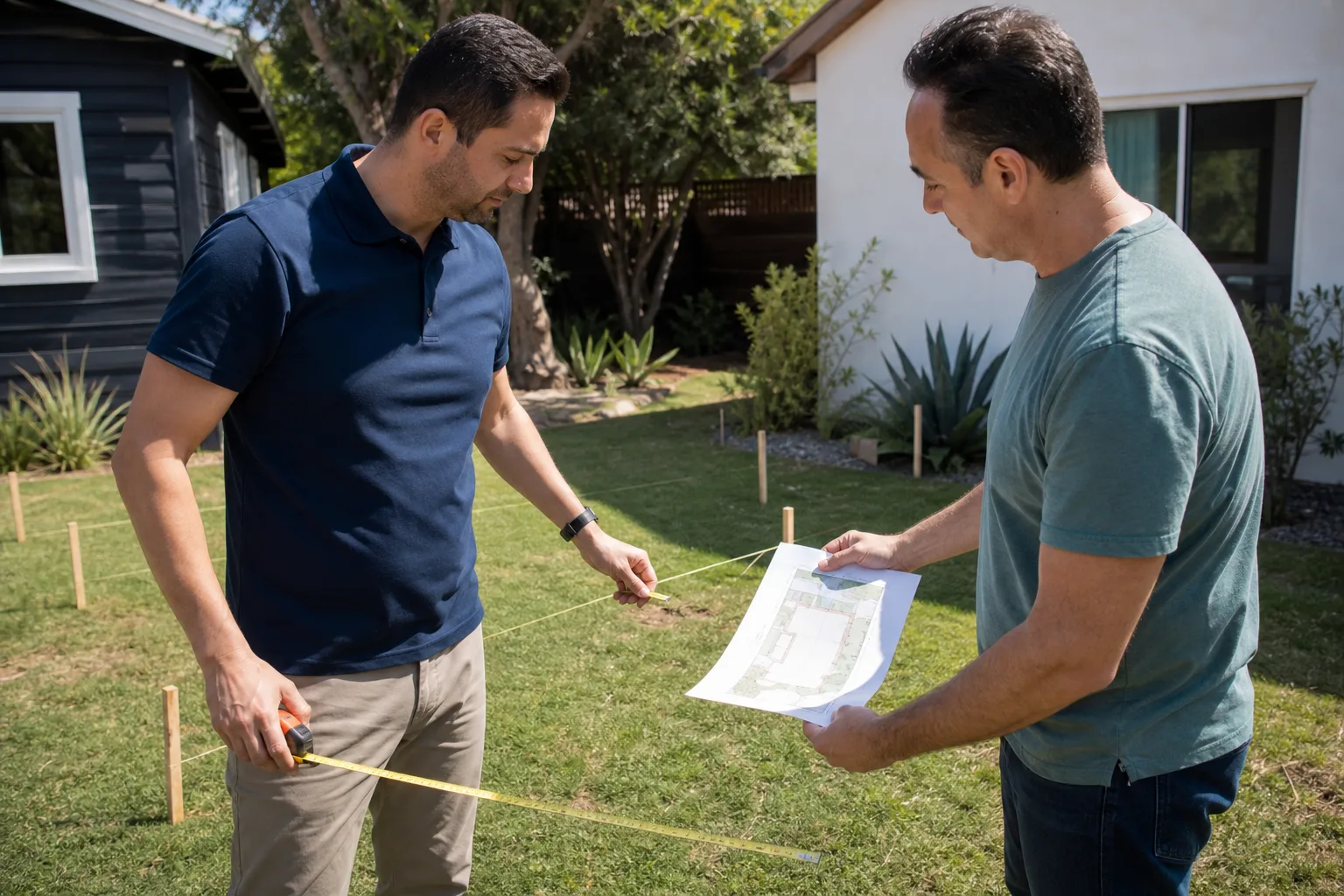
- They measure the site. Setbacks (the required distance between your new structure and the property lines), drainage gradients, and utility easements all matter on a Winchester room addition. A builder who walks your yard without a tape or a site plan isn’t collecting the information needed for a real number.
- They ask about permits. Room additions require building permits and inspections, and in Winchester the review can surface setbacks, HOA considerations, or lot-coverage limits. A builder who glosses over permits or offers to “handle it later” is setting up a compliance problem.
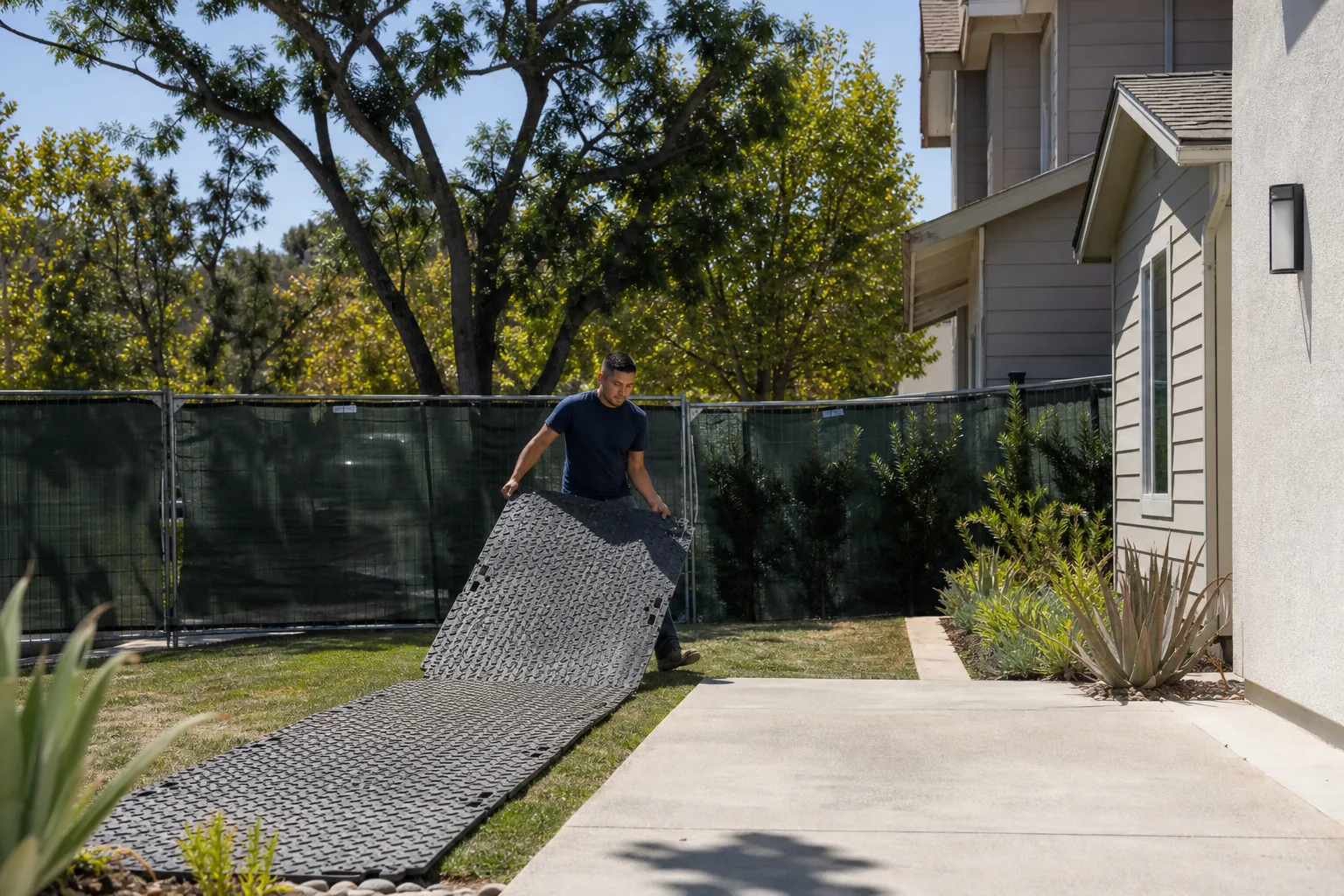
- They discuss your access route. Material deliveries, equipment staging, and driveway access affect the schedule. A builder who mentions these on the first visit is thinking about the job; one who doesn’t is thinking about the sale.
- They tell you who’s coming. Not “a crew.” Names, photos, and badges. This is a straightforward question to ask in a sales conversation, and there’s no good reason for a builder to dodge it.
- They hand you a written scope of work. The number can come later in the process, but the scope should be captured early and in writing.
Why Winchester Room Additions Present Specific Risks
Clark County’s climate pushes hard against any unproven builder. Summer surface temperatures in Winchester regularly exceed 180°F on unshaded concrete, and a room addition that connects to your existing wall creates a thermal bridge where the old envelope meets the new. Roofs, stucco systems, and window flashing all get cooked on the south and west exposures through July and August. If the builder hasn’t thought about the transition between the existing structure and the addition, we know from experience that you’ll discover it as a water intrusion problem the first winter you own the room.
Newer subdivisions in Winchester add two more wrinkles. HOA architectural review requirements and recorded lot-coverage limits constrain how much footprint you can add, and what side of the lot you can build it on. A builder who doesn’t ask to see your CC&Rs and HOA architectural submittal process is skipping a step that has stopped more than a few projects mid-permit.
Material choice matters too. James Hardie cementitious siding and stucco assemblies are both common in the valley, and each behaves differently under the sun. The right choice depends on your existing construction type and the exposure of the new wall, not on what’s on the builder’s standard list. For detached units on the same lot, the envelope and HVAC decisions are similar to a room addition, and the reference standard doesn’t change. Compare a stamped, warranted process against what your lowball bidder offers by reviewing Home Addition Contractor in Winchester standards before you sign anything.
Common Mistakes to Avoid
- Signing before reading the termination clause. The contract’s exit language is the one paragraph homeowners skip. Read it first, and if it allows only the builder to walk away, don’t sign until it’s fixed.
- Comparing total bids instead of line-item bids. Two bids with a $40,000 spread are rarely about quality. They’re about what got left out. Line them up line by line, and the gap reveals itself.
- Accepting “we’ll pull permits later.” Room additions in Clark County need permits and inspections, and pulling them after construction starts risks stop-work orders and rework. Never let a builder skip the permit step to save a month.
- Treating an unverified crew as a personality flaw. A five-month build with a rotating, unvetted crew is a security gap on your property while you’re home alone with kids. It’s a hiring criterion, not a footnote.
- Not asking the reference for the final cost. The three numbers – timeline accuracy, change-order count, and final versus quoted cost – are the whole story. A reference who can’t produce them is a reference you can’t use.
- Checking the license but not the classification. A contractor licensed for a different scope isn’t licensed for your room addition. Verify the classification in the NSCB database matches your job.
- Skipping the HOA review on a corner or side-yard addition. Winchester HOAs routinely limit lot coverage. Discover the limit before design, not after permit submittal.
- Paying a large deposit with no milestone schedule. Money should follow completed, inspectable stages of work. A front-loaded payment schedule is you financing the builder’s cash flow.
When to Call a Professional
Call a professional when the scope goes beyond cosmetic work and touches foundation, framing, electrical, plumbing, or the building envelope. If you’re adding livable square footage, converting a garage, or building a detached unit, that’s a permitted, inspected, multi-trade project. It’s also a project where the wrong contract language costs real money. Call us when you’ve collected bids and want a line-item explanation of what the fair price should look like, or when a contract you’ve been handed has gaps you can’t resolve on your own. Sutton ADU Builders Winchester offers free estimates in Winchester. Call (844) 761-9367 to schedule yours, and we’ll walk you through the written price and the scope before anything is signed.
Frequently Asked Questions
Most room additions in Winchester run roughly $250 to $450 per square foot finished, before site work and permit fees, with the higher end driven by foundation complexity, envelope transitions to the existing structure, and finish selections. A 300-square-foot addition typically lands somewhere around $75,000 to $135,000 total. Call (844) 761-9367 for a free written estimate on your specific lot.
Yes, by comparing line items rather than totals. Look at allowances for fixtures and finishes, whether site work and permit fees are included, and whether the bid specifies brands for materials. A bid with zero contingency, low allowances, and vague “per plans” language is structurally low. Call (844) 761-9367 and we’ll go through the comparison with you.
Ask for the license number in writing, then look it up yourself in the Nevada State Contractors Board (NSCB) database. Confirm the status is active, the classification covers residential room additions, the record shows no disciplinary actions, and the license name matches the contract name exactly. A licensed, insured contractor will hand you the number without hesitation.
Yes. Room additions require building permits and inspections, and the plan review process will surface setback, lot-coverage, and HOA considerations specific to your lot. Never work with a builder who suggests pulling permits after construction starts or who treats the permit step as optional. A permitted, inspected project protects you when you sell the home.
A good reference can quote timeline accuracy, change-order frequency, and the difference between final cost and quoted cost. Character praise without those three data points tells you nothing. If a homeowner can’t produce those numbers, ask whether the contractor ever gave them the final invoice breakdown in writing.
You should expect a written workmanship guarantee with a defined duration and a stated remedy. The 365-Day Done Right Promise we operate under covers defects in workmanship for one full calendar year from project completion, and if something isn’t right, we make it right. A vague verbal assurance is not a guarantee. Call (844) 761-9367 for the written terms before you sign.
The Bottom Line
The warning signs that predict a bad room addition almost all appear before construction begins. Missing termination clauses, no lien waiver process, vague scope language, unverified crews, and lowball bids structured to recover margin through change orders. None of those are visible from the curb. All of them are visible on paper. Audit the contractor, not just the quote. Verify the license yourself in the NSCB database, ask references the three questions that matter, compare line items on every bid, and require a written price and a defined scope before any work begins. Those habits cost you nothing and save tens of thousands. When you’re ready to price a project, start with Sutton ADU Builders Winchester home and see how a stamped, written, warrantied process looks side by side with what you’ve been handed.
Call (844) 761-9367 for a free estimate on your room addition or ADU. We’ll walk you through the written price, the scope, and the crew verification before you commit to a single dollar.
Written by the team at Sutton ADU Builders Winchester.